

How to store solar panels in India so they do not crack: stacking, repacking and rooftop kits
How EPC companies, distributors and dealers in India can store solar panels without cracks, plus inverters, batteries, repacking and rooftop kits.
Your panels have landed at Mundra or Chennai, or a full truck is on its way from a factory in Gujarat. The site is not ready yet or your installers will want the panels a few at a time over the next few months. Until then they wait in a warehouse and every lift, stack and opened pallet is a chance to crack them.
This guide is for EPC companies, distributors and dealers across India. It explains why panels crack and what the manufacturers' own manuals say about stacking and storing them. It also covers inverters and batteries, repacking panels for smaller trips and building rooftop kits.
- Checked on arrival
- Stacked as the pallet says
- Kept dry and covered
- Inverters on racks
- Batteries kept apart
- Repacked for the trip
- Kits picked item by item
1. Why solar panels crack
A panel is a sheet of glass over thin silicon cells. The cells crack when the panel bends or takes a knock. That happens when:
- a forklift's forks hit the pallet or its glass side;
- a pallet tilts at the container door or gets dropped;
- pallets are stacked higher than the manufacturer allows, so the bottom ones carry the weight;
- someone stands on a panel or drops a tool on it;
- a panel is laid down hard with its glass side up, even from a few centimetres;
- the truck ride shakes the load.
Most of these cracks cannot be seen with the eye. The glass looks whole while the cells inside are cracked. Test labs find cracks with an electroluminescence (EL) image, which shows them as dark lines across the cells.
A cracked panel may lose little power at first. A study by ISFH, a German solar research institute, notes that the loss often shows only after more stress, such as repeated heating and cooling on a roof. What a business feels first is broken glass, panels to replace and a dispute over who caused the damage.
One Indian manufacturer's manual asks buyers to note any damage on the lorry receipt at delivery, with photos and serial numbers. Damage found inside the pallets must be reported within 15 days. Damage from moving the panels again later is not covered by its transit insurance. Without a record at each handover, nobody can tell a factory crack from a road crack.
We record each pallet's condition when it reaches us and again when it leaves.
2. What the manufacturers' manuals say about stacking and storage
Every panel manufacturer publishes handling and storage instructions, and the warranty depends on following them. One manual says warranty claims will be refused if anyone has stood on the panels. The three manuals we read agree on most points but their numbers differ, so keep the manual for each model with the stock.
Read the pallet before you stack it
Most panels now travel standing on edge in their pallet. One manual says horizontal packing is not allowed in transport at all. The same manual sorts its pallets into two kinds. Landscape packs may go two high, with the top pallet sitting squarely on the one below. Portrait packs must not be stacked at all. The markings on the pallet tell you which kind you have.
Two high at most and one outdoors
Both Indian manuals we read set the limit at two pallets high. One adds that outdoors only one pallet should stand, under a protective cover. Leave a gap between pallets so a forklift can get in without scraping the cartons.
Dry, flat and out of the sun
The manuals ask for:
- a dry, ventilated store on flat, hard ground;
- humidity and temperature inside the limits printed in the manual;
- no direct sun on the pallets;
- the original packaging left on, as it keeps out water and dust;
- no corrosive chemicals or flammable gases nearby;
- access only for the people who need it.
For long stays the manuals prefer a proper warehouse to an open yard, with regular checks. A carton that gets wet goes soft and rain pooling on a cover can bring a stack down. If panels must wait outside, they stand on hard, raised, drained ground and get covered in rain. The cover comes off on a dry day so the cartons can dry out.
Nothing on top of a pack
No one walks, sits or stands on the packs and nothing heavy goes on top of them. Racks must take the full weight of a pallet without bending.
Unloading and forklifts
The forklift must be rated for the pallet's weight. Its forks should reach at least three quarters of the way under the pallet, or extension sleeves go on so the pack cannot tip. The driver enters from the pallet's short side and keeps the forks away from the glass side. A crane is the last resort, with nylon slings, never wire rope. Nobody unloads in high wind or heavy rain.
We lift and stack each pallet the way the panel manufacturer asks. Pallets go only as high as the manufacturer allows and they stay dry and covered.
3. Once a pallet is opened
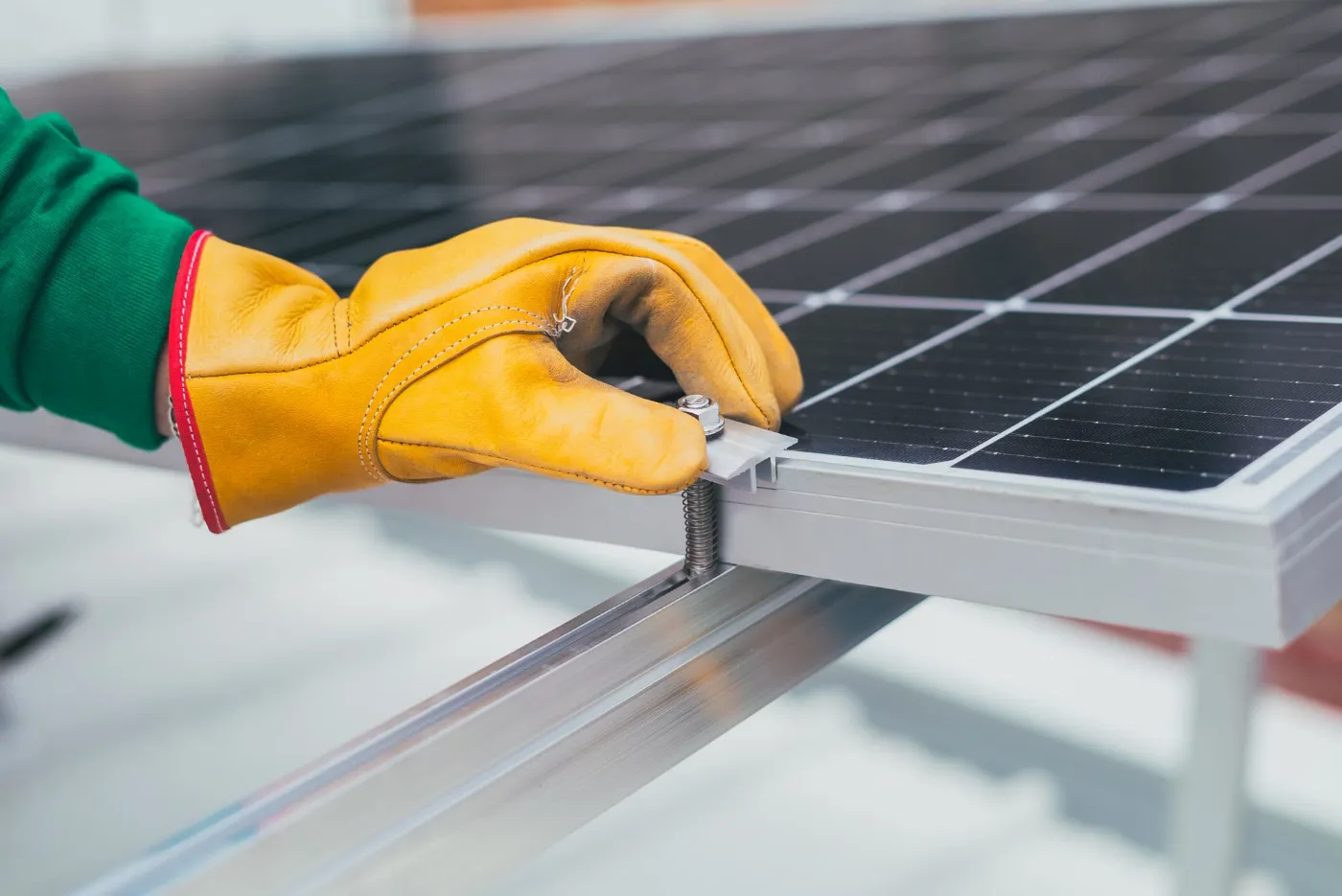
Rooftop orders mean opening pallets, and single panels are easiest to damage. The manuals agree on these rules:
- Two people carry a panel, never one.
- Nobody lifts a panel by its cable or junction box.
- Panels never lean against a pole or anything else that can move.
- Pallets are not opened in strong wind or rain.
The manuals differ on how loose panels should lie. Two allow a short flat stack on a pallet in a set order with the frames lined up. Another advises against laying one panel straight onto another. Follow the manual for your model.
Panels left in an opened pallet are no longer held as the factory packed them. Before they travel again they need new packing (section 5).
4. Inverters, batteries and the rest of the kit
A solar distributor holds more than panels. Each part of the stock needs its own place.
Inverters
Inverter manuals ask for the original box to stay on with its bag of desiccant, which soaks up moisture. They want a cool place out of the sun, with no condensation. Boxes stack only as high as the label on the box allows. One manual asks for a professional check before use if an inverter has sat in store for more than two years.
We keep inverters on racks by model so every order gets the right one.
Lithium batteries
Lithium batteries count as dangerous goods for transport. A damaged one can catch fire and the fire spreads fast to whatever is stored beside it. Insurers' guides ask for bulk stock to be kept in its own area with space around it. They also ask for damaged or returned batteries to be kept away from good stock.
Battery manuals set a storage temperature, a charge level and how often a stored battery needs its charge checked. The numbers differ from one product to the next. If batteries will wait for months, agree before they arrive who checks the charge.
We keep lithium batteries in a separate, safe area of our warehouse, away from your other stock.
Structures, cables and small parts
In our warehouses mounting rails and legs lie flat, sorted by length and type, so a truck can be loaded without digging through the pile. Cable coils, connectors and fasteners sit in labelled bins by size.
Serial numbers
Each panel has its own serial number, sealed inside the glass. The packing list on the pallet carries every serial in it. Manufacturers ask for serials in any damage claim, and rooftop subsidies check panels built with Indian cells serial by serial.
We record each panel's serial number as it comes in and as it goes out, so you can show which serials went to which installer or site.
5. Repacking panels for smaller trips
A factory pallet suits a full truck to a project site. A dealer wants a few cartons, and an installer may want a handful of panels. Once a pallet is opened, the panels need packing that suits the trip. Loose panels in a part load can shift and knock on the road.
We repack panels in four ways, each for a different trip:
- Corrugated cartons. Small lots go in strong cartons, ready to travel as parcels to installers.
- Cartons with side foam. Foam on the edges and corners takes the knocks for panels sent on their own.
- Wrapped and strapped pallets. Cartons go on a pallet with bubble wrap and straps, ready for part loads to dealers.
- Strapped straight into the truck. For a full load to a site, we pack the panels in the truck with bubble wrap and cartons, then strap them in.
Ask any warehouse which packs it uses and match the pack to the trip.
6. Building rooftop kits item by item
A rooftop job needs everything on the same day. One missing connector or a cracked panel can hold up the whole installation.
A typical rooftop kit holds:
- the panels, with their serial numbers listed;
- the inverter;
- DC and AC cables;
- the mounting structure, with its rails, legs and clamps;
- the earthing kit, connectors and the AC and DC boxes.
We pick each kit item by item against the installer's order. We hold the stock for it so the parts are there when the kit is due. Each panel's serial is recorded as the kit goes out. Orders then leave the way each buyer needs them: a full truck to a project site, part loads to dealers and parcels to installers.
Questions solar buyers ask
How high can you stack solar panel pallets?
Most manufacturers allow two pallets high at most, indoors. One Indian manufacturer advises only one pallet high outdoors, under a cover. Some pallet types must not be stacked at all, so check the markings on the pallet and the manual for your model.
Should solar panels be stored flat or on edge?
In their pallets most panels travel and wait standing on edge, as the factory packed them. Once a pallet is opened, follow your model's manual. Some allow a short flat stack in a set order and others advise against laying one panel on another.
Can solar panels be stored outdoors?
For a short time, if the ground is hard, level and drained and the pallets are covered in rain. Manufacturers prefer a warehouse for longer stays because wet cartons go soft and stacks can collapse. Some ask for only one pallet high outdoors.
Can you see microcracks in a solar panel?
Usually not. The glass can look whole while the cells inside are cracked. Test labs find cracks with an electroluminescence (EL) image. That is why each pallet's condition should be recorded when it arrives.
Should lithium batteries be stored with solar panels?
No. Keep lithium batteries in their own area, away from panels and other stock, as insurers' guides advise. Keep damaged batteries apart from good ones. Battery manuals also say how often the charge should be checked while they wait.
What goes in a rooftop solar kit?
The panels, the inverter, DC and AC cables, the mounting structure, the earthing kit, connectors and the AC and DC boxes. The exact list follows the installer's order. Picking each item against that order helps the kit reach the roof complete.
Last updated


